The Collar Heard Round Hollywood: How Tracee Ellis Ross Made Jonathan Anderson’s Dior Debut Unforgettable
Darling, when Tracee Ellis Ross steps onto a red carpet, she doesn’t simply arrive—she makes a statement that reverberates through the fashion stratosphere. Wednesday evening’s “Being Eddie” documentary premiere at Los Angeles’ Tudum Theater proved no exception, as the style icon delivered what may be the most compelling endorsement yet of Jonathan Anderson’s nascent tenure at Dior.
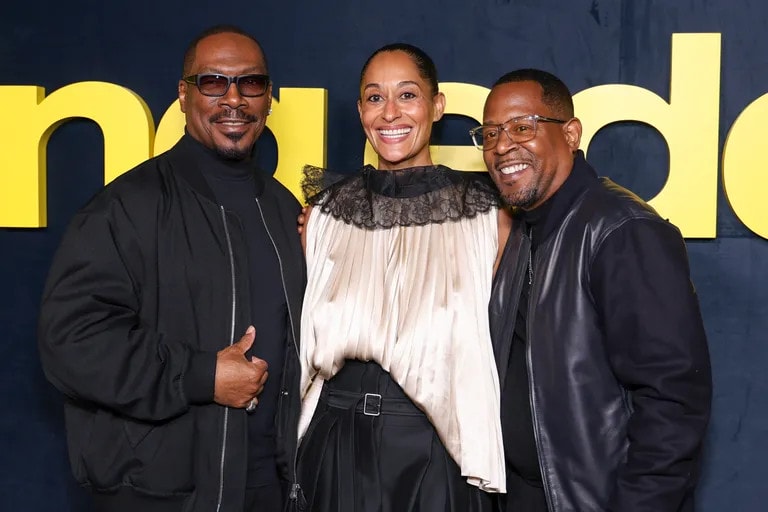
While Eddie Murphy and his entourage adhered to the evening’s de rigueur all-black dress code, Ross—ever the sartorial disruptor—had other plans entirely. Courtesy of her visionary stylist Karla Welch, the actress secured Look 38 from Dior’s Spring 2026 collection, marking Anderson’s inaugural womenswear presentation as the storied maison’s eighth couturier, succeeding Maria Grazia Chiuri.
source: Getty Images
The ensemble was nothing short of architectural poetry. Ross’s cream-colored silk sleevless top featured exquisite all-over pleating with a deliciously bubbled hem, expertly tucked into Anderson’s elevated interpretation of Bermuda shorts—wide-leg capri trousers with a perfectly belted waist that whispered sophistication rather than resort-wear casualness.
But let’s address the pièce de résistance: that extraordinary collar. Imagine, if you will, a free-standing transparent black lace structure that defied gravity, stretching from the crewneck beyond Ross’s nose in a cone of intricate embroidery. Part Elizabethan ruff, part haute couture fantasy, this show-stopping accent encircled the entirety of her bodice, creating a fanned mystique that only Anderson’s boundary-pushing imagination could conceive. The genius? The lace construction can be folded down atop the champagne top for mere mortals attempting street styling, though Ross wisely kept hers dramatically elevated for maximum impact.
source: Getty Images
This is Anderson leaning into what WWD’s Joelle Diderich astutely observed as “Dior’s architectural approach,” though rather than reverentially quoting the house’s historic H-line or A-line silhouettes, he’s authored his own vocabulary entirely. In his show notes, Anderson described the collection as “a play between harmony and tension”—a philosophy embodied perfectly in Ross’s avant-garde neckline juxtaposed against those refreshingly wearable trousers.
Ross demonstrated impeccable editorial instinct by keeping accessories minimal—simple black pumps and virtually no jewelry—allowing Anderson’s couture craftsmanship to command undivided attention. It’s the mark of a true fashion connoisseur: knowing when less is exponentially more.
source: Getty Images
Anderson’s debut runway presentation, witnessed by a front row glittering with Dior ambassadors including Charlize Theron, Anya Taylor-Joy, and Greta Lee, has drawn inevitable comparisons to his acclaimed work at Loewe. Yet Ross’s red carpet moment proves that Anderson’s Dior isn’t merely recycling greatest hits—it’s establishing an entirely new lexicon of feminine power dressing.
source: Getty Images
In an industry obsessed with playing it safe, Tracee Ellis Ross reminds us why fashion matters: because sometimes, wearing a gravity-defying lace collar to celebrate Eddie Murphy is exactly the kind of audacious joy we need. Anderson’s Dior era has officially arrived, and if Ross is any indication, it’s going to be spectacular.
Bianca Fernandes is a rising fashion and lifestyle blogger making waves in the industry. On her blog 'Bianca's Style File', she shares her passion for all things chic and glamorous. With a background in fashion journalism, Bianca has her finger firmly on the pulse when it comes to the latest trends and must-have items. Her keen eye for style and knack for mixing high-end and high-street pieces has garnered her a loyal following. When she's not blogging, you can find Bianca at fashion shows scoping out next season's collections, discovering up-and-coming designers, and rubbing shoulders with fashion insiders to get the inside scoop for her readers. Bianca's style savviness and infectious enthusiasm for fashion shines through in her writing.
Bella Hadid Victoria’s Secret Fashion Show headlines wrote themselves the moment the lights dropped in Los Angeles. The 2026 spectacle, which staged its comeback...
Kendall Jenner polka dot heels were the unexpected showstopper of Saturday night, when the supermodel arrived at the sixth annual Academy Museum Gala in...
Kim Kardashian Black Open-Toe Heels: 5 Stunning Reasons
Kim Kardashian black open-toe heels proved that restraint can be the loudest statement in the room. Arriving...