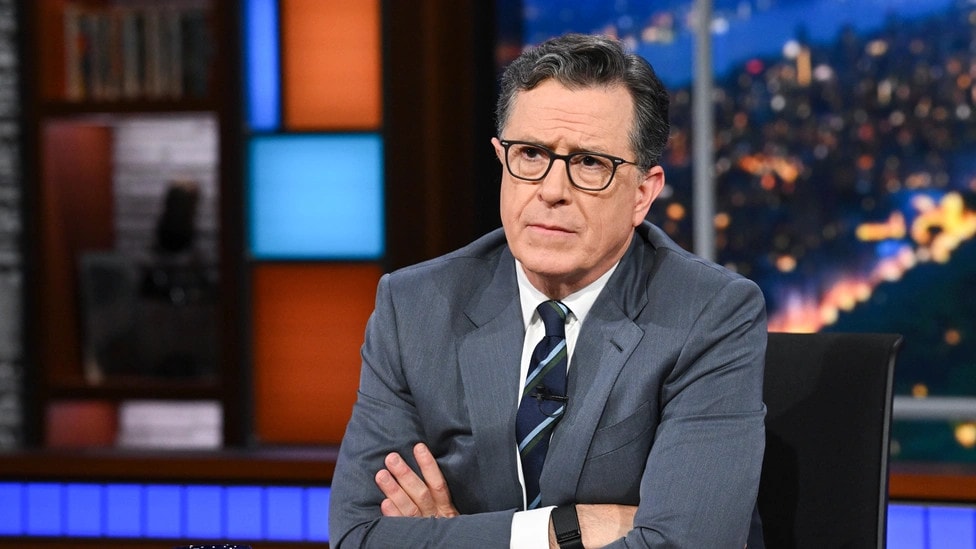
The Last Laugh: How Stephen Colbert’s Exit Marks the End of Traditional Late-Night Television
In a move that has sent shockwaves through the entertainment constellation, CBS delivered devastating news that will forever alter the landscape of late-night television. The network announced Thursday the cancellation of “The Late Show With Stephen Colbert,” bringing to a close not just a decade-long reign but the conclusion of a storied franchise that has graced our screens for over three decades.
The decision, described by CBS executives as “purely financial” against the backdrop of a challenging late-night environment, marks the end of Colbert’s tenure when his contract expires this May. The announcement came with all the gravity of a fashion house closing its doors—sudden, impactful, and leaving an indelible mark on the industry it once dominated.
“Our admiration, affection and respect for the talents of Stephen Colbert and his incredible team made this agonizing decision even more difficult,” stated George Cheeks, CBS president and co-chief executive of Paramount, the network’s parent company. The sentiment echoed through the historic Ed Sullivan Theater, where Colbert has held court since 2015, transforming from Comedy Central provocateur to late-night royalty.
source: Getty
The timing of this announcement has raised eyebrows across the entertainment industry, particularly given Paramount’s ongoing multibillion-dollar merger with Skydance—a deal requiring approval from the Trump administration. The plot thickens with Paramount’s recent $16 million settlement with President Trump over a “60 Minutes” interview, a move Colbert himself criticized as “a big fat bribe” during his show.
This cancellation represents more than just the end of one program; it signals a seismic shift in how America consumes entertainment. The late-night genre, once the crown jewel of network television, has been hemorrhaging viewers to streaming platforms. In a telling industry milestone, streaming services overtook broadcast and cable as the primary distribution method for video entertainment just last month.
The numbers tell a stark story of decline. Late-night advertising revenue has plummeted from $439 million in 2018 to a mere $220 million last year—a devastating 50 percent drop that would make even the most seasoned media executive’s head spin. The Emmy Awards, television’s most prestigious honor, could only muster three nominations for best talk show this year due to lack of submissions, compared to six nominees just years ago.
source: Getty
Colbert’s journey to late-night supremacy reads like a classic comeback story. After taking over from David Letterman in 2015, he initially struggled to find his footing, alarming CBS executives as ratings languished. However, his sharp political commentary and laser focus on topical news—particularly his pointed criticism of then-President Trump—catapulted “The Late Show” past Jimmy Fallon’s “Tonight Show” in early 2017, where it remained triumphant for eight consecutive years.
The political undertones of this cancellation have not gone unnoticed. Senator Adam Schiff, who appeared as a guest on Thursday’s show, took to social media questioning whether the decision was politically motivated. “If Paramount and CBS ended ‘The Late Show’ for political reasons, the public deserves to know,” he declared.
Senator Elizabeth Warren echoed these concerns, stating, “CBS canceled Colbert’s show just three days after Colbert called out CBS owner Paramount for its $16 million settlement with Trump—a deal that looks like bribery. America deserves to know if his show was canceled for political reasons.”
The broader implications extend beyond one show’s fate. The late-night landscape has become increasingly barren, with hosts like Trevor Noah and James Corden voluntarily departing in 2022, citing desires to explore opportunities beyond the traditional talk show format. CBS’s decision to cancel “After Midnight” following Taylor Tomlinson’s departure in March, with no plans to replace it, suggests the network is retreating from the late-night battlefield entirely.
The cancellation of “The Late Show With Stephen Colbert” may well mark the end of an era—not just for one beloved host, but for an entire genre that once defined American television’s nighttime landscape.
Bianca Fernandes is a rising fashion and lifestyle blogger making waves in the industry. On her blog 'Bianca's Style File', she shares her passion for all things chic and glamorous. With a background in fashion journalism, Bianca has her finger firmly on the pulse when it comes to the latest trends and must-have items. Her keen eye for style and knack for mixing high-end and high-street pieces has garnered her a loyal following. When she's not blogging, you can find Bianca at fashion shows scoping out next season's collections, discovering up-and-coming designers, and rubbing shoulders with fashion insiders to get the inside scoop for her readers. Bianca's style savviness and infectious enthusiasm for fashion shines through in her writing.
Bella Hadid Victoria’s Secret Fashion Show headlines wrote themselves the moment the lights dropped in Los Angeles. The 2026 spectacle, which staged its comeback...
Kendall Jenner polka dot heels were the unexpected showstopper of Saturday night, when the supermodel arrived at the sixth annual Academy Museum Gala in...
Kim Kardashian Black Open-Toe Heels: 5 Stunning Reasons
Kim Kardashian black open-toe heels proved that restraint can be the loudest statement in the room. Arriving...