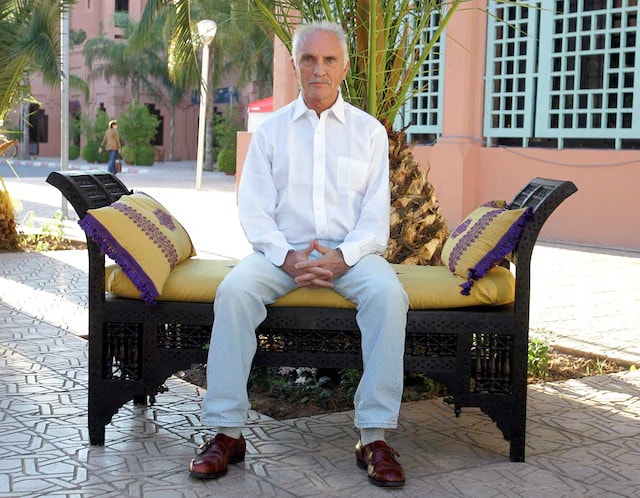
The Last Close-Up: Terence Stamp’s Transformative Legacy Lives On After Death at 87
In the grand theater of cinema, certain stars burn with an incandescent brilliance that transcends mere celebrity—they become cultural totems, style icons whose very presence elevates the art of storytelling. Terence Stamp, the British virtuoso who graced our screens for over six decades, has taken his final bow at the age of 87, leaving behind a legacy as multifaceted as the most exquisite couture creation.
The announcement came with the quiet dignity befitting a man who never courted scandal but instead let his craft speak volumes. His family’s statement, released through Reuters on that fateful Sunday, August 17th, spoke of “an extraordinary body of work” that will continue to “touch and inspire people for years to come”—words that feel as carefully tailored as a Savile Row suit.
From his breakthrough in 1962’s “Billy Budd,” where his ethereal beauty and commanding presence earned him an Oscar nomination, Stamp possessed that indefinable quality that separates mere actors from screen legends. His face—angular, aristocratic, with those piercing blue eyes—became a canvas upon which directors painted some of cinema’s most memorable characters.
source: Tim Francis / Getty Images
But it was perhaps his fearless embrace of transformation that truly set Stamp apart in an industry often constrained by typecasting. Consider his audacious turn in “The Adventures of Priscilla, Queen of the Desert,” where he embodied Bernadette with such authenticity that he literally reshaped his spine for the role. “From wearing the high heels, my spine was completely out of alignment,” he revealed to CBS News, demonstrating the physical dedication that would make any method actor weep with envy.
His portrayal of the megalomaniacal General Zod in the Superman franchise remains a masterclass in villainy—camp yet terrifying, theatrical yet grounded. When Stamp commanded Superman to “kneel before Zod,” he delivered the line with such imperious authority that it became instant pop culture gospel, cementing his place in the superhero pantheon.
The breadth of his filmography reads like a curated exhibition of cinematic excellence: from Pasolini’s avant-garde “Theorem” to Soderbergh’s gritty “The Limey,” from Burton’s gothic fantasies to his swan song in Edgar Wright’s stylish “Last Night in Soho.” Each role seemed chosen not for commercial appeal but for artistic merit—a luxury afforded only to those secure in their craft and confident in their choices.
source: Tim Francis / Getty Images
What distinguished Stamp from his contemporaries was his refusal to be confined by conventional masculinity. In an era when leading men were expected to project unwavering strength, Stamp dared to explore vulnerability, androgyny, and complexity. His collaborations with visionary directors like Pasolini and Fellini positioned him as more than an actor—he became a muse for cinematic poetry.
As tributes pour across social media platforms, one thing becomes crystalline: Terence Stamp didn’t merely inhabit roles; he transformed them into cultural artifacts. His death marks not just the loss of a performer, but the end of a particular kind of fearless artistry that seems increasingly rare in our algorithmic age.
In fashion, we often speak of timeless pieces—garments that transcend seasonal trends to become eternal. Terence Stamp’s performances possess that same enduring quality, remaining as relevant and mesmerizing today as they were decades ago, ensuring his legacy will continue to inspire long after the final credits roll.
Mary Janika is the rising star in the world of fashion blogging. As a self-proclaimed 'shoe-aholic', Mary launched the blog 'Shoe Queen' to share her love of all things fashion footwear. Based in New York City, the epicenter of the fashion world, Mary constantly has her finger on the pulse when it comes to the latest and greatest shoe trends. From thigh-high boots to sky-high stilettos, Mary provides glimpses into her enviable personal shoe collection and serves up advice on how to style shoes for any occasion. With her down-to-earth attitude and humor-filled posts, Mary has cultivated an enthusiastic following of fellow shoe lovers. When she's not blogging, you'll find Mary thrifting vintage footwear, chatting up shoe designers about their newest collections, and of course, expanding her already-impressive lineup of heels and flats. For top-notch tips from a true shoe queen, look no further than Mary Janika and the Shoe Queen blog.
Bella Hadid Victoria’s Secret Fashion Show headlines wrote themselves the moment the lights dropped in Los Angeles. The 2026 spectacle, which staged its comeback...
Kendall Jenner polka dot heels were the unexpected showstopper of Saturday night, when the supermodel arrived at the sixth annual Academy Museum Gala in...
Kim Kardashian Black Open-Toe Heels: 5 Stunning Reasons
Kim Kardashian black open-toe heels proved that restraint can be the loudest statement in the room. Arriving...