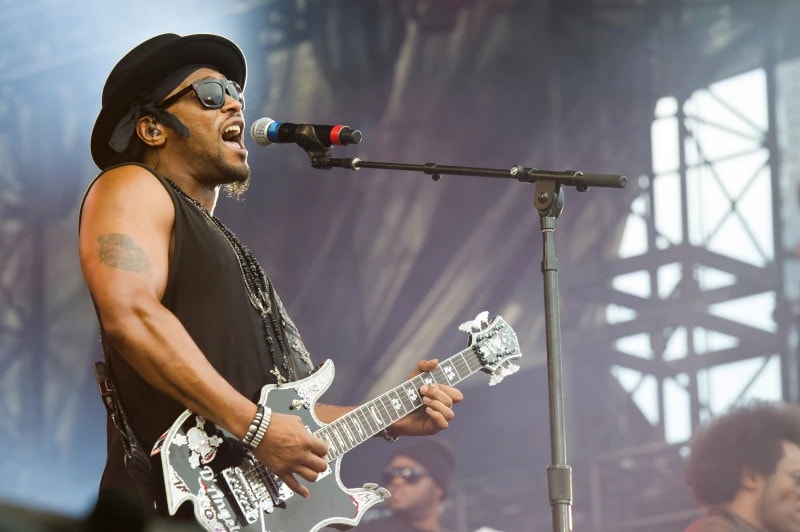
Remembering D’Angelo: The Soulful Genius Who Redefined R&B
In an untimely turn of events, the world of music and culture has lost one of its brightest stars. Michael Eugene Archer, better known as D’Angelo, passed away at the age of 51 after a brave battle with cancer. Known for his unparalleled vocal ability, his soulful depth, and his unique ability to blend genres with ease, D’Angelo’s death leaves an irreplaceable void in the music industry. His family confirmed the news on Tuesday, describing him as “a shining star of our family” whose light has now dimmed. In their statement, they expressed their “eternal gratitude for the legacy of extraordinarily moving music” that he leaves behind, one that continues to resonate with fans, musicians, and artists worldwide.
D’Angelo was not just a voice; he was a movement. His music embodied the heart of neo-soul, fusing elements of gospel, R&B, and hip-hop to craft a sound that felt both revolutionary and timeless. With his debut album, Brown Sugar (1995), he introduced the world to a fresh, raw sound, earning multiple Grammy nominations. The album, which produced unforgettable tracks such as “Lady” and the title track, was a game-changer in the 1990s music scene. It was not only a commercial success but also an artistic statement, highlighting his mastery of vocal control and emotional depth.
However, it was his 2000 album Voodoo—and the unforgettable, minimalist music video for “Untitled (How Does It Feel)”—that would solidify D’Angelo as an iconic cultural figure. The music video, where D’Angelo appears shirtless, captivated the world. It was more than just a visual; it was an exploration of sensuality, vulnerability, and Black male representation in ways that had never been seen before. The video ignited conversations about sexuality, artistry, and self-expression, marking a pivotal moment in both the music and fashion worlds.
source: Charles Sykes/Invision/AP
The success of “Untitled (How Does It Feel)” led to a Grammy for Best Male R&B Vocal Performance, propelling Voodoo to the top of the Billboard 200 charts and earning the award for Best R&B Album. D’Angelo’s idiosyncratic approach to artistry, much like the late Prince, was rooted in his devotion to the craft, never compromising his artistic integrity for commercial success. In an interview with The Associated Press in 2000, he remarked, “Musicians have gotten trapped into that mode of thinking marketable and commercial. That destroys art, that destroys the essence of what it is about…You cannot make music like that. That’s not what this is about.” And indeed, D’Angelo never did.
Beyond his own career, D’Angelo was a highly respected collaborator. His contribution to Lauryn Hill’s The Miseducation of Lauryn Hill on the track “Nothing Even Matters” stands as one of the finest examples of musical partnership. He also worked with The Roots, contributing to their 1996 album Illadelph Halflife, and was part of the supergroup Black Men United, whose 1994 track “U Will Know” for the film Jason’s Lyric became an anthem in its own right.
source: Charles Sykes/Invision/AP
D’Angelo’s profound influence on fellow artists was undeniable. Actor and musician Jamie Foxx paid tribute on social media, recalling the first time he heard D’Angelo’s music: “I remember hearing your music for the first time… I said to myself damn whoever this is they are anointed.” Foxx, who later saw D’Angelo perform live at the House of Blues, described the experience as nothing short of magical. “Your voice was silky and flawless,” Foxx wrote. “I was graciously envious of your style and your swag…”
In the years since Voodoo, D’Angelo’s public appearances were rare, but his cultural impact remained ever-present. The music he created transcended the constraints of time, offering a soulful escape that was both deeply personal and universally relatable. As the world processes this profound loss, the legacy of D’Angelo—the musician, the artist, and the man—will continue to influence the direction of modern R&B and inspire generations to come.
Mary Janika is the rising star in the world of fashion blogging. As a self-proclaimed 'shoe-aholic', Mary launched the blog 'Shoe Queen' to share her love of all things fashion footwear. Based in New York City, the epicenter of the fashion world, Mary constantly has her finger on the pulse when it comes to the latest and greatest shoe trends. From thigh-high boots to sky-high stilettos, Mary provides glimpses into her enviable personal shoe collection and serves up advice on how to style shoes for any occasion. With her down-to-earth attitude and humor-filled posts, Mary has cultivated an enthusiastic following of fellow shoe lovers. When she's not blogging, you'll find Mary thrifting vintage footwear, chatting up shoe designers about their newest collections, and of course, expanding her already-impressive lineup of heels and flats. For top-notch tips from a true shoe queen, look no further than Mary Janika and the Shoe Queen blog.
Bella Hadid Victoria’s Secret Fashion Show headlines wrote themselves the moment the lights dropped in Los Angeles. The 2026 spectacle, which staged its comeback...
Kendall Jenner polka dot heels were the unexpected showstopper of Saturday night, when the supermodel arrived at the sixth annual Academy Museum Gala in...
Kim Kardashian Black Open-Toe Heels: 5 Stunning Reasons
Kim Kardashian black open-toe heels proved that restraint can be the loudest statement in the room. Arriving...