The New Minimalism: Why ‘Alien: Earth’s’ Utilitarian Glamour Is Fashion’s Next Big Moment
In the hallowed halls of fashion editorial, we’ve witnessed countless trends come and go, but rarely does a television series arrive with such exquisite attention to the marriage of function and form as Noah Hawley’s “Alien: Earth.” As someone who has chronicled the evolution of style from Milan’s most exclusive runways to Hollywood’s most coveted red carpets, I can confidently declare that this series represents nothing short of a sartorial revolution.
Set in the year 2120, “Alien: Earth” presents a vision of future fashion that feels both achingly familiar and thrillingly avant-garde. The costume design team has crafted a world where practicality meets luxury in the most unexpected ways, creating what I can only describe as “utilitarian glamour”—a trend I predict will dominate the next decade of fashion consciousness.
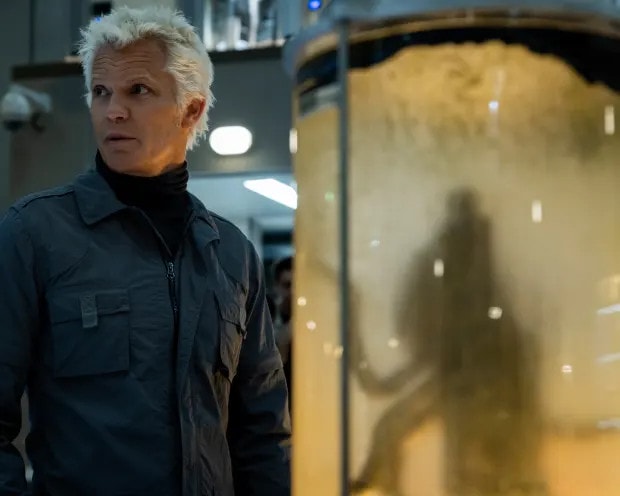
The crew aboard the USCSS Maginot exemplifies this new aesthetic paradigm. Their uniforms speak to a post-apocalyptic chic that would make Rick Owens weep with envy. The weathered textures, the strategic layering, the way fabric moves against synthetic materials—it’s all deeply intentional, deeply fashionable. These aren’t merely costumes; they’re declarations of a world where survival and style have merged into something transcendent.
source: Patrick Brown/FX
But it’s the corporate elite who truly steal the sartorial spotlight. Boy Kavalier, the young trillionaire portrayed with delicious intensity by Samuel Blenkin, embodies what I’m calling “Barefoot Billionaire Chic”—a aesthetic movement that marries Mark Zuckerberg’s studied casualness with the gothic romanticism of Mary Shelley’s vision. His wardrobe choices speak to a generation of power brokers who understand that true luxury lies not in ostentation, but in the quiet confidence of understatement.
The hybrid characters present perhaps the most fascinating fashion narrative of all. These beings—human consciousness housed in synthetic perfection—wear their artificial bodies like the most exquisite haute couture. Their clothing doesn’t merely cover; it enhances, it communicates, it transforms. Each garment tells the story of humanity’s desperate reach toward immortality, wrapped in fabrics that shimmer between the organic and the engineered.
What strikes me most profoundly about the series’ aesthetic choices is how they mirror our current moment’s obsession with sustainable fashion and ethical production. In this future world, where corporations like Weyland-Yutani and Prodigy control not just markets but human destiny itself, clothing becomes both armor and art. The way fabric drapes across both human and synthetic forms raises questions that feel startlingly contemporary: What does it mean to be authentic when everything can be engineered?
source: Patrick Brown/FX
The production design, filmed in Thailand’s Studio Park outside Bangkok, creates an atmosphere where every textile choice feels weighted with meaning. The contrast between the sterile corporate environments and the lived-in spaces of the working class crew tells a story that fashion has always told—about power, about identity, about who gets to define beauty and why.
As we watch these characters navigate their treacherous landscape, their wardrobes serve as silent narrators. The way a synthetic being adjusts their collar, how a hybrid child inhabits an adult body through clothing choices, the manner in which survival gear transforms into statement pieces—it’s all pure poetry in motion.
This is fashion storytelling at its most sophisticated, where every button, every seam, every carefully chosen accessory contributes to a larger narrative about humanity’s future. “Alien: Earth” doesn’t just present us with clothes; it presents us with a philosophy of dress that speaks to our deepest anxieties and highest aspirations.
The series premieres with the kind of visual confidence that makes this fashion editor’s heart sing. In a world increasingly concerned with artificial intelligence and human enhancement, “Alien: Earth” offers a wardrobe that’s both warning and promise—a sartorial glimpse into tomorrow that feels urgently relevant today.
Bella Hadid Victoria’s Secret Fashion Show headlines wrote themselves the moment the lights dropped in Los Angeles. The 2026 spectacle, which staged its comeback...
Kendall Jenner polka dot heels were the unexpected showstopper of Saturday night, when the supermodel arrived at the sixth annual Academy Museum Gala in...
Kim Kardashian Black Open-Toe Heels: 5 Stunning Reasons
Kim Kardashian black open-toe heels proved that restraint can be the loudest statement in the room. Arriving...