Apocalypse Now: How ’28 Years Later’ Predicts Fashion’s Post-Pandemic Future
In the rarified world of cinema where couture meets catastrophe, Danny Boyle’s return to his dystopian masterpiece with “28 Years Later” isn’t just a cinematic event—it’s a sartorial statement that fashion insiders simply cannot ignore. After living through our own global pandemic, Boyle’s vision feels less like science fiction and more like a brutally honest mirror reflecting our collective anxieties about isolation, survival, and what remains when civilization’s veneer is stripped away.
The film’s aesthetic—shot primarily on iPhones by the visionary cinematographer Anthony Dod Mantle—creates an intimately raw visual language that fashion photographers have been desperately trying to capture for years. This isn’t the polished apocalypse we’ve grown accustomed to in Hollywood blockbusters; this is apocalypse as lived experience, messy and immediate, with a visual texture that feels pulled from the most avant-garde editorial spreads.
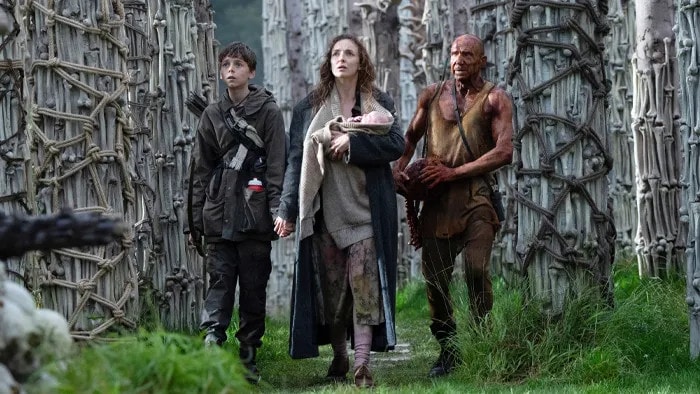
What’s particularly fascinating from a fashion perspective is how “28 Years Later” embraces what I’m calling “medieval survivalism chic.” The inhabitants of Holy Island, particularly Jamie (the devastatingly handsome Aaron Taylor-Johnson) and his family, embody a return to pre-industrial aesthetics that feels surprisingly relevant to our current fashion moment. Think Rick Owens meets “Game of Thrones,” but with the authentic patina of genuine hardship rather than constructed fantasy.
The film’s costume design—though “costume” feels almost insulting for such organic, lived-in clothing—presents a masterclass in utilitarian beauty. These aren’t the pristine distressed jeans we see on runways; these are garments that have genuinely lived, breathed, and survived. The makeshift watchtowers and primitive weapons create a backdrop that fashion’s most experimental designers—from Demna at Balenciaga to Jonathan Anderson at Loewe—would kill to replicate in their next collections.
Jodie Comer’s portrayal of the bedridden Isla offers perhaps the most poignant fashion moment in the film. Stripped of any traditional markers of style or beauty, she embodies a kind of raw femininity that transcends traditional fashion narratives. It’s vulnerability as the ultimate luxury—something our Instagram-obsessed culture has forgotten how to authentically portray.
Young Alfie Williams as Spike represents the next generation’s relationship with both survival and style. His character arc—questioning the “macho world he’s being raised in”—mirrors fashion’s own evolution away from rigid gender norms toward something more fluid and questioning. His coming-of-age story unfolds against a backdrop that forces us to reconsider what truly matters when everything else falls away.
The film’s “gratingly disjointed” visual approach, as critics have noted, actually mirrors fashion’s current obsession with deconstruction and chaos. Boyle’s frenetic direction creates a visual language that fashion photographers like Juergen Teller and Corinne Day pioneered decades ago—beauty found in imperfection, truth discovered in chaos.
Perhaps most brilliantly, “28 Years Later” refuses to go global in the way most franchises do. Instead, it remains stubbornly, defiantly British—quarantined like a luxury brand that refuses to compromise its vision for mass appeal. This insularity creates a fashion microcosm where style isn’t dictated by global trends but by immediate survival needs.
The stone causeway that connects the survivors to the mainland becomes a perfect metaphor for fashion’s relationship with the outside world—accessible only at certain times, dangerous to cross, but impossible to ignore. It’s a physical manifestation of fashion’s eternal tension between isolation and connection, exclusivity and accessibility.
In our post-pandemic world, where luxury has been redefined and authenticity has become the ultimate currency, “28 Years Later” offers a brutal but beautiful vision of what fashion might look like when stripped of pretense. It’s apocalypse chic at its most genuine—and most terrifying.
Beth Hans is an experienced fashion blogger and heel aficionado based in Los Angeles. With over 10 years in the industry, Beth has developed a keen eye for the latest and greatest trends in women's heels and footwear. On her popular blog 'Heels of Style', Beth provides in-depth reviews on today's top designer heels, recommends must-have shoes for any occasion, and shares expert tips on how to walk gracefully and pain-free in even the highest stilettos. When she's not blogging, you can find Beth searching local boutiques for hidden gem shoe brands and attending Fashion Week runway shows to spot the heel styles of the upcoming season. With her vast knowledge and passion for elevated foot fashion, Beth Hans is considered one of the top experts on all things high heels.
Bella Hadid Victoria’s Secret Fashion Show headlines wrote themselves the moment the lights dropped in Los Angeles. The 2026 spectacle, which staged its comeback...
Kendall Jenner polka dot heels were the unexpected showstopper of Saturday night, when the supermodel arrived at the sixth annual Academy Museum Gala in...
Kim Kardashian Black Open-Toe Heels: 5 Stunning Reasons
Kim Kardashian black open-toe heels proved that restraint can be the loudest statement in the room. Arriving...